

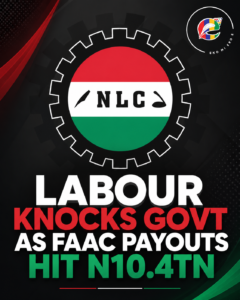
Nigeria’s three tiers of government received a total of N10.45 trillion from the Federation Account Allocation Committee between January and May 2026.
The figure represents a 25.85 percent increase compared to the N8.30 trillion shared during the same period in 2025.
Despite the rise in revenue, the Nigeria Labour Congress and private sector stakeholders have criticised governments at all levels over worsening living conditions, poor infrastructure and rising insecurity.
According to an analysis by The PUNCH, the allocations were distributed to the Federal Government, 36 states, the Federal Capital Territory and 774 local government areas from a gross government revenue of N13.76 trillion realised within the five-month period.
This was higher than the N13.19 trillion recorded in the corresponding period of 2025.
The increase in distributable revenue was linked to stronger Value Added Tax collections, higher oil-related tax receipts and the revenue drive of the Nigeria Revenue Service.
A breakdown of the 2026 FAAC data showed that the Federal Government received N3.72 trillion, while state governments received N3.56 trillion.
Local governments got N2.51 trillion, while the 13 oil-producing states shared N673.17 billion as derivation revenue.
Monthly allocations rose from N1.96 trillion in January to N2.30 trillion in May.
The payout declined slightly in February to N1.89 trillion, before rising to N2.04 trillion in March, N2.26 trillion in April, and N2.30 trillion in May.
Compared to the same months in 2025, May 2026 recorded the highest jump, rising by 38.55 percent from N1.66 trillion to N2.30 trillion.
The Federal Government emerged as the biggest beneficiary of the five-month allocation, receiving more than both local governments and the oil-producing states.
However, labour leaders argued that higher allocations have not translated into better welfare for citizens.
The NLC said the issue is not only the amount of money available to government, but the willingness of leaders to use public resources to improve the lives of workers and ordinary Nigerians.
The development has renewed public concern over the gap between rising government revenue and the realities faced by citizens, including high living costs, weak infrastructure, insecurity and pressure on household income.
For many Nigerians, the central question remains whether increased revenue will lead to visible improvements in governance, public services and quality of life.