



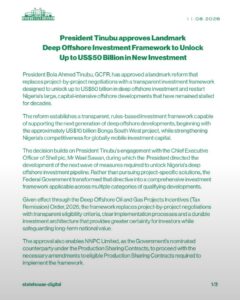
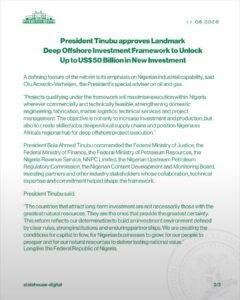
President Bola Ahmed Tinubu has approved a new framework aimed at unlocking up to $50 billion in fresh investment for Nigeria’s deep offshore oil and gas industry, in another major push to revive stalled projects and strengthen the country’s position in the global energy market. (Reuters)
The new framework introduces regulatory and fiscal measures intended to provide greater clarity and predictability for investors considering capital-intensive offshore developments in Nigeria.
A significant feature of the reform is the move away from negotiating incentives separately for individual projects towards a more transparent framework applicable to qualifying investments. The government hopes this will reduce uncertainty, accelerate investment decisions and make Nigeria’s deepwater sector more internationally competitive. (TheCable)
The latest measure builds on a series of reforms undertaken by the Tinubu administration to attract investment into Nigeria’s oil and gas industry. In January, the President approved targeted, investment-linked incentives to support Shell and its partners’ proposed Bonga South West deep-offshore project, stressing that the incentives would be tied to new capital, incremental production, local content and in-country value creation. (State House).
Nigeria possesses substantial offshore hydrocarbon resources, but several major projects have faced years of delays amid concerns over costs, regulatory uncertainty and investment conditions.
The new framework is therefore expected to provide a clearer path for investors considering large-scale projects requiring billions of dollars in long-term capital.
If the targeted investment is realised, the initiative could have wider implications for Nigeria’s economy through increased oil and gas production, foreign exchange inflows, employment opportunities, local industry participation and government revenues.
It also comes as Nigeria competes with other oil-producing nations for global energy capital at a time when international investors are becoming increasingly selective about where they commit funding.
For the Federal Government, the challenge will now move from policy announcement to implementation. The extent to which the framework delivers the projected investment will depend on regulatory consistency, investor confidence and the ability to translate incentives into final investment decisions and operating projects.
With as much as $50 billion potentially at stake, the initiative represents one of the administration’s most ambitious attempts yet to reposition Nigeria’s deep offshore sector as a major destination for global energy investment.