
Heavyweight boxing has always been the ultimate proving ground a division where one punch can create a champion or end a legacy. It is a stage built on courage, resilience, and moments that define sporting history.
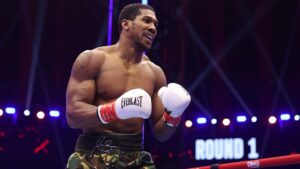
Last weekend in Jeddah, Saudi Arabia, Anthony Joshua reminded the boxing world why he remains one of the sport’s biggest attractions. The former two-time heavyweight world champion climbed off the canvas twice before stopping Albania’s Kristian Prenga in the second round with a dramatic technical knockout (TKO).
It was a performance that showcased both vulnerability and resilience. Joshua looked in serious trouble during the opening round after Prenga landed a sharp uppercut before flooring him again with a powerful right hand. For a brief moment, questions resurfaced about whether the years, setbacks, and personal tragedies had finally caught up with the British-Nigerian heavyweight.
Joshua answered those questions emphatically.
Returning for the second round with greater composure, he established his jab, improved his movement, and regained control of the contest. His trademark right hand eventually found its target, sending Prenga crashing through the ropes and forcing the referee to halt the fight.
The victory represented far more than another win on Joshua’s record.
It marked his first major outing since the tragic road accident on the Ibadan Expressway in late 2025, which claimed the lives of two close friends and members of his team. The emotional weight of that loss made his return all the more significant.
Following the bout, Joshua reflected on the experience with honesty.
> “I learned a valuable lesson.”
His words reflected the mindset of a fighter who has experienced both championship glory and painful setbacks throughout an extraordinary career.
Born on October 15, 1989, in Watford, England, to Nigerian parents from Ogun State, Joshua rose to global prominence after winning Olympic gold at the London 2012 Games. He successfully transitioned into the professional ranks, capturing multiple heavyweight world titles and becoming one of boxing’s biggest global stars.
Throughout his career, Joshua has defeated some of the division’s most respected names, including Wladimir Klitschko, Joseph Parker, Alexander Povetkin, Dillian Whyte, Kubrat Pulev, Otto Wallin, and Francis Ngannou.
His professional record now stands at 30 victories, four defeats, and 27 knockouts, underlining his reputation as one of heavyweight boxing’s most devastating punchers.
However, the heavyweight division rarely forgives mistakes.
Joshua has endured memorable defeats to Andy Ruiz Jr., Oleksandr Usyk, and Daniel Dubois results that prompted many observers to question whether another championship reign was possible.
His victory over Prenga has reopened that conversation.
While his heart, determination, and knockout power remain unquestionable, defensive lapses against elite opposition could prove costly. If Joshua was dropped twice by Prenga, how would he fare against fighters such as Oleksandr Usyk, Daniel Dubois, Tyson Fury, Agit Kabayel, Joseph Parker, Fabio Wardley, Filip Hrgović, Moses Itauma, or Deontay Wilder?
Only future performances will provide the answer.
The Road Back to the Top
The heavyweight division remains one of the most competitive eras in modern boxing.
Oleksandr Usyk continues to lead the division as the universally recognised heavyweight champion, while Daniel Dubois also holds a major world title. Rising contenders including Agit Kabayel, Joseph Parker, Fabio Wardley, Filip Hrgović, Moses Itauma, Martin Bakole, Efe Ajagba, and Zhilei Zhang continue to intensify competition at the top level.
Joshua remains firmly in the championship picture, and another impressive victory over a leading contender could place him back in mandatory title contention.
Yet one fight continues to capture the imagination of boxing fans across the world.
Anthony Joshua versus Tyson Fury.
For years, the all-British heavyweight showdown has remained boxing’s biggest fight never to happen. Failed negotiations, mandatory title obligations, and changing circumstances have repeatedly delayed the contest.
With both fighters rebuilding momentum, optimism is growing that the long-awaited clash could finally become reality.
In heavyweight boxing, every contest is only one punch away from history.
Joshua still possesses that punch.
Bringing Anthony Joshua Home
Joshua has never hidden his Nigerian heritage.
With family roots in Ogun State, hosting one of his future fights in Lagos, Abeokuta, or Abuja would represent one of the greatest sporting events ever staged on African soil.
The National Sports Commission, alongside the Federal Government, Lagos State Government, and Ogun State Government, should actively explore the possibility of bringing Joshua home for a world-class boxing event.
Such an occasion would stimulate sports tourism, inspire young athletes, attract international media attention, encourage investment in sports infrastructure, and reinforce Nigeria’s position as a destination capable of hosting major global sporting events.
Nigeria’s rich boxing history deserves such recognition.
The country has produced legendary champions including Dick Tiger, Hogan “Kid” Bassey, Samuel Peter, and, more recently, Israel Adesanya, whose success across combat sports has inspired millions around the world.
As the saying goes:
“Champions are not those who never fall; champions are those who always beat the count.”
Anthony Joshua beat the count.
He answered doubts with action instead of words.
He reminded the world that even when a lion stumbles, it never forgets how to hunt.
Whether this victory marks the beginning of one final championship run or simply another memorable chapter in an already remarkable career remains uncertain.
One thing, however, is clear.
Anthony Joshua is back in the heavyweight conversation.
The belts remain within reach.
History is waiting.
And somewhere beyond the ropes, another bell is preparing to ring.