
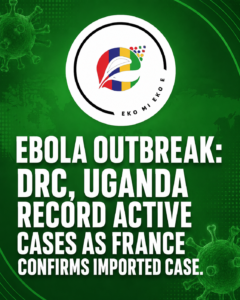
Health authorities are closely monitoring the ongoing Ebola outbreak affecting the Democratic Republic of the Congo and Uganda, as France confirms an imported case linked to the same public health situation.
The outbreak is caused by the Bundibugyo species of Ebola virus, a rare strain for which there is currently no approved vaccine or specific treatment. The World Health Organization says the outbreak was confirmed in the Democratic Republic of the Congo and Uganda in May 2026.
The Democratic Republic of the Congo remains the main epicentre of the outbreak, with confirmed cases reported in affected areas including Ituri, Nord-Kivu and Sud-Kivu provinces.
According to recent updates, the outbreak in DRC has surpassed 1,000 confirmed cases, with hundreds of deaths recorded. Health officials say the response has been challenged by insecurity, population movement, pressure on local health systems, treatment capacity, contact tracing and safe burial concerns.
Uganda has also recorded cases linked to the outbreak. WHO reports show that several of the confirmed cases in Uganda were imported from the Democratic Republic of the Congo, while some secondary transmission was also recorded among contacts and health workers.
France has now confirmed an imported Ebola case involving a doctor who recently returned from a humanitarian mission in the Democratic Republic of the Congo.
The patient has been isolated and is receiving specialised medical care. Authorities have also begun contact tracing, with identified close contacts being monitored in line with Ebola response protocols.
Health officials have stressed that the case in France is an imported case and has not been described as community transmission. The wider public risk in France and across Europe is currently considered low.
Ebola is a severe disease that can spread through direct contact with the bodily fluids of an infected person, contaminated materials or infected animals. Symptoms may include fever, fatigue, muscle pain, headache, vomiting and diarrhoea. In severe cases, it can lead to internal or external bleeding.
The Bundibugyo strain presents additional concern because, unlike some other Ebola strains, there is no licensed vaccine or specific treatment currently approved for it. Early supportive care, quick isolation, contact tracing, safe burials and strong public health communication remain critical to controlling the outbreak.
As of the latest updates, the countries currently linked to the active Ebola situation are:
Democratic Republic of the Congo: Main outbreak epicentre, with active transmission reported.
Uganda: Active cases linked to the same outbreak.
France: Imported case involving a doctor who returned from DRC; no community transmission reported.
Health agencies continue to urge the public to follow official updates, avoid misinformation and cooperate with prevention measures in affected areas.
The situation remains developing, and further updates are expected as health authorities continue monitoring the outbreak.